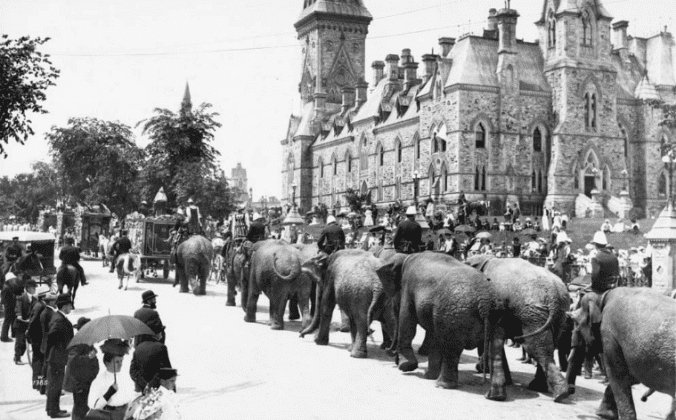

When did the circus first appear in Ottawa? Few contemporary residents would remember, as the first performance dates back to 1851. In those times, circuses announced their arrival with parades, creating an extravagant spectacle to draw attention to their upcoming shows.
Let I Ottawa take you through the origins of circus arts and the story of the first performances.
The Great Eastern Circus
In 1851, life in Bytown was challenging. The population was small, and workers endured a six-day workweek for minimal pay. Entertainment options were scarce, with tavern visits being the most common leisure activity. Wealthier Ottawa residents had the privilege of attending dramatic performances by Huff’s Dramatic Company, where tickets cost 25 cents per seat.
The arrival of a circus was an exhilarating event for the townsfolk. For many, it was their first time seeing exotic animals and mysterious performers.
In August 1851, the Great Eastern Circus, led by James M. June and Seth Howes, arrived in Bytown after touring other Canadian cities like Montreal and Toronto. For Howes, this was a return visit; he had previously brought his National Circus of New York, a horse show, to Bytown in 1840, a memorable occasion for the town.

The Journey to the City and Ticket Prices
At the time, Bytown was not connected to the outside world by railway, making the journey arduous. Interestingly, ticket prices were the same for adults and children, even though the first circuses were not initially intended for younger audiences.
The June & Company Circus made a grand entrance into Bytown with a procession of eight Syrian camels and loud announcements promising a spectacular showcase of talent.
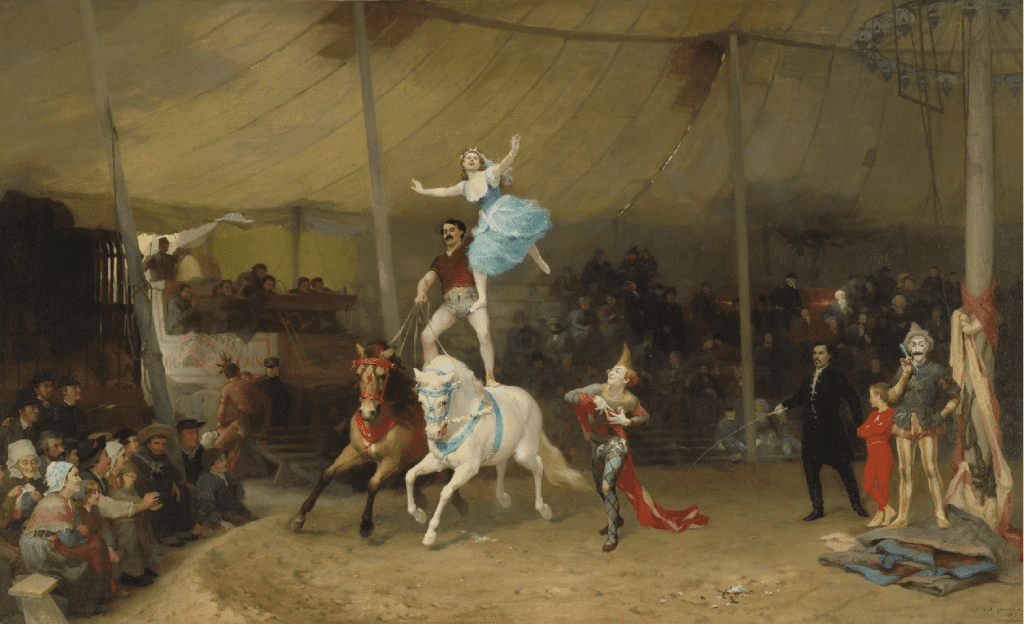
Circus performances primarily revolved around equestrian acts, featuring skilled riders and remarkable horses. Other highlights included:
- Acrobatics with impressive flips;
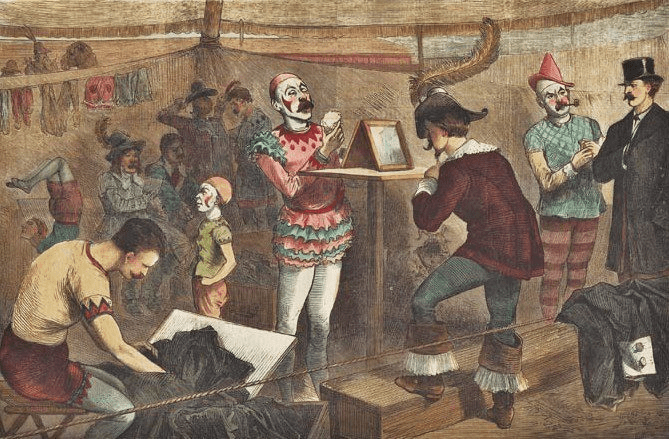
- A clown who also performed as a storyteller, equestrian, and sledgehammer handler;
- Pole acrobatics with daring tricks.
Shows began at 2:30 PM and lasted three hours.
The First Circus in Bytown – The Ottawa Citizen
The arrival of the circus sparked excitement and debates among locals. A week prior to the event, The Ottawa Citizen published an article with mixed reviews about the upcoming performance.
Subsequent circuses regularly visited Bytown, eagerly anticipated by its residents. With the introduction of railway connections, the variety of performances expanded, and competition among circuses increased. This not only lowered ticket prices but also encouraged the creation of innovative acts, as audiences grew tired of the standard repertoire of riders, clowns, and tumblers.
Barnum & Bailey Circus
Known as “The Greatest Show on Earth,” the Barnum & Bailey Circus was the most renowned circus of the late 19th century to visit Ottawa. The show’s magnificence reignited public interest, with each visit surpassing the last in grandeur.
The circus, created by legendary showmen Phineas Taylor Barnum and James Anthony Bailey, was a product of the golden age of American circuses. By the late 19th century, over 50 circuses were touring the continent, captivating audiences with their spectacular performances.
The Barnum & Bailey Circus visited Ottawa six times, each time delivering an even more dazzling experience than before.
Phineas Taylor Barnum
Born in 1810, Barnum began his career in New York City and later acquired Scudder’s American Museum in 1841, renaming it after himself. The museum featured a zoo, aquarium, freak shows, and a lecture hall.
One of its most famous exhibits was the Fiji Mermaid, promoted as the mummified remains of a mermaid from the Pacific Ocean. Thousands flocked to see it, though it was later revealed to be a fabricated artifact made from the body of a monkey and the tail of a fish. After the museum burned down, Barnum turned his attention to the circus, founding the P.T. Barnum’s Grand Traveling Museum, Menagerie, Caravan, and Hippodrome in 1871. He was one of the first to transport a circus by railway, revolutionizing the industry.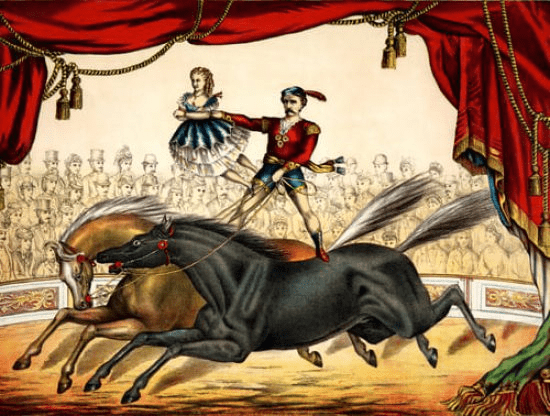
James A. Bailey
Born in 1847, Bailey was an orphan who took his surname from the man who introduced him to the circus industry. In the early 1870s, he partnered with the traveling “Cooper & Bailey Circus” and competed with Barnum. In 1881, the two joined forces to create “The Greatest Show on Earth.”
The star attraction of their circus was Jumbo, a massive African elephant that became a sensation. Ottawa audiences saw Jumbo during his tours in 1883 and 1885. Tragically, the elephant’s final performance occurred just days before his untimely death at a railway station in Ontario.
Circuses in Ottawa
Among the six major circuses that visited Ottawa in the late 19th century, the Barnum & Bailey Circus was the largest. Transporting the show required four specially equipped trains with 68 cars to carry performers, staff, animals, tents, and equipment.
The circus parade began at 9:30 AM, featuring a vibrant display of performers, animals, and musicians. Crowds enthusiastically lined the streets to watch. Tickets cost 50 cents for adults and 25 cents for children under nine. This circus was notable for including a female ringmaster and clown, and performances spanned 110 acts across three rings and two stages simultaneously.
After Bailey’s death, the circus was acquired by the Ringling Brothers.
Great Forepaugh & Sells Brothers
On June 29, 1907, the Great Forepaugh & Sells Brothers Circus held a promotional event on Sparks Street and near the Sapper’s Bridge, showcasing the grandeur of the upcoming show. Highlights of this circus included:
- Costumes made from the finest silk and cloth;
- Carriages and wagons adorned with gold leaf;
- A production budget of $1 million in 1907;
- Performances featuring elephants.
The circus visited Ottawa in 1899, 1902, and 1904, before ceasing operations in 1911.
The Popularity of Circus Arts
Ottawa residents eagerly anticipated the arrival of each new circus, drawn by the lack of alternative entertainment and the thrill of exotic animals, breathtaking stunts, and magical performances. While the novelty of circus acts waned over time, the unique atmosphere and enchanting experiences continued to captivate audiences, transporting them to a fantastical world unlike any other.