

Near the bustling ByWard Market stands the National Gallery of Canada. Both locals and visitors to Ottawa can discover not only historical but also contemporary works of art within its walls. Paintings, sculptures, photographs, and multimedia installations draw in crowds. It’s a must-see destination, and iottawa.net has more details.
Brief Historical Overview
Before delving into the National Gallery of Canada’s modern history, let’s touch on its beginnings.
In 1880, Canada’s Governor General John Campbell first established the gallery in collaboration with the Royal Canadian Academy of Arts. Two years later, the gallery moved to a building on Parliament Hill, which also housed Canada’s Second Supreme Court.
In 1910, Eric Brown was appointed as the National Gallery’s first director, and by 1911, the institution had relocated to the Victoria Memorial Museum building, which also held the National Museum of Natural Sciences.
Over the following decades, the gallery’s history and cultural value continued to grow. A National Gallery Act was passed in 1913, and expansion followed in the 1920s. Eventually, the Victoria Memorial Museum building could no longer accommodate the gallery’s growing collection. In 1952, a design contest for a permanent gallery building was held, but the government decided against supporting the winning proposal.
Instead, the government offered the eight-story Lorne Building for the gallery’s use. The National Gallery then moved to an office building on Elgin Street, which was eventually torn down and replaced by a 17-story office structure for the federal Department of Finance.
In 1968, the National Museums of Canada Corporation absorbed the National Gallery of Canada. Renovation of the Lorne Building was finished in 1976, but by 1980, it was clear another move would soon be necessary. The building’s condition was poor, and it lacked sufficient exhibit space.
In 1982, Prime Minister Pierre Trudeau announced a renewed focus on national development favouring the arts. His plan involved constructing permanent buildings for the National Gallery of Canada and the Museum of Man, with a five-year completion goal. Construction began on Sussex Drive in 1985, and the new facility opened in May 1988.
Additionally, in 2000, the Royal Architectural Institute of Canada named the gallery building one of the 500 best structures erected in the country over the previous millennium.

The Gallery’s Collections
By October 2018, the National Gallery of Canada’s permanent collection contained over 93,625 works, representing various artistic movements and eras. The gallery’s first acquisitions were works by Canadian artists, underscoring its commitment to featuring Canadian art at the institution’s core.
Over time, the collection expanded through purchases and donations of works by artists from around the world. Notably, the gallery organizes its own travelling exhibitions, touring both Canada and other countries.
Around 1,500 contemporary artworks from the 1990s onward form part of the current collection. The first contemporary Indigenous Canadian piece acquired by the gallery was “North American Iceberg” (1985) by Carl Beam.
In 2017, marking the gallery’s 150th anniversary, Bob Rennie donated 197 contemporary artworks—paintings, sculptures, and mixed-media pieces—to the institution.
The National Gallery of Canada’s Library and Archives, founded in 1880, is home to an extensive array of literature on Canadian art. Its holdings include 275,000 books, exhibition catalogues, and periodicals, along with 76,000 documentation files and 95,000 microforms. The archives also serve as the gallery’s institutional archive.
Related Associations
The National Gallery of Canada is a premier cultural institution working with other groups that advance Canadian art and museum initiatives:
- Canadian Museums Association: A national non-profit organization advocating for museums across Canada, supporting museum professionals’ development.
- Galeries Ontario/Ontario Galleries (GOG), formerly the Ontario Association of Art Galleries, established in 1968 to promote public art galleries and museums.
- Canadian Heritage Information Network, offering a network interface for Canadian heritage institutions.
- Digital Museums Canada, a funding program dedicated to online projects by museums and heritage communities, aiding organizations in enhancing their digital capacity.
Their combined efforts nurture and expand Canada’s museum sector, ensuring public access to cultural heritage.

Notable Features of the National Gallery of Canada
Visitors can appreciate the following highlights:
- Louise Bourgeois’ spider sculpture greeting everyone at the entrance.
- The museum’s striking architecture by Moshe Safdie—an artistic fusion of granite and glass.
- Exhibits showcasing ancient Indigenous artifacts, religious artworks from New France, paintings by the Group of Seven, plus modern Inuit sculptures.
- Canada’s best collection of European art, as well as strong holdings of Asian and global works.
- One of the world’s most comprehensive photography collections and related materials.
- A lovely indoor courtyard garden where guests can relax.
Additionally, the National Gallery of Canada offers panoramic views of Ottawa and Gatineau.

Essential Information
The National Gallery of Canada is located at 380 Sussex Drive in Ottawa. The gallery building spans 46,621 square metres, including 12,400 square metres of exhibition space. For inquiries, call 613-990-1985 or toll-free at 1-800-319-2787. The site has Wi-Fi and accessible washrooms.
From May to September, the gallery is open daily from 9:30 a.m. to 5 p.m., with extended hours on Thursdays until 8 p.m. From October to April, it’s closed Mondays; from Tuesday to Sunday, it runs 9:30 a.m. to 5 p.m., with extended hours on Thursdays until 8 p.m.
If you plan on visiting with a large group, book in advance. Underground parking is available for a fee; nearby street parking is an option. Wheelchairs and strollers are provided in the foyer.
When exploring the collections, watch for “No Photos” signs that restrict photography of certain pieces. Canadians can become members of the gallery—membership can be purchased online, at the admissions desk, or via the membership office. Perks include free access to the gallery’s collections and exhibitions, exclusive previews, and a 15% discount for NGC members.
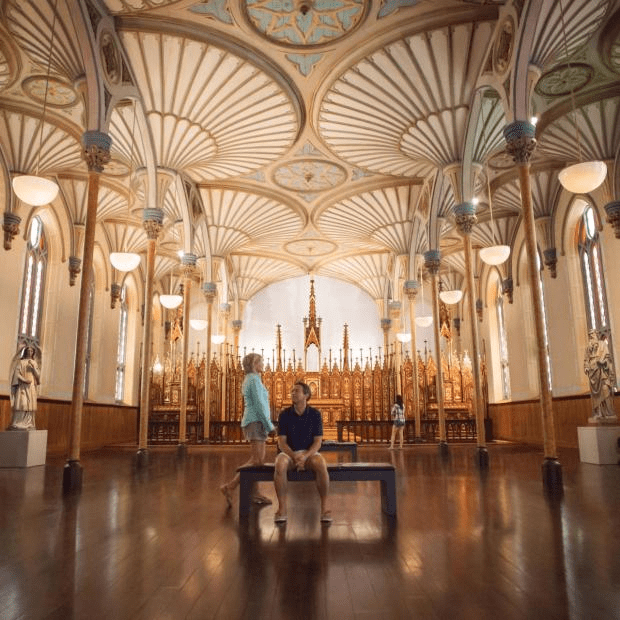
Often featured in weekend to-do lists, the National Gallery of Canada provides a cultural escape to enrich your inner world. There’s a café or wine bar on-site if you’d like a break. If you can’t make it in person, you can take a virtual tour of the gallery.