
In the 20th century, Ottawa was home to a truly gifted inventor who dedicated his life to innovation—George Klein. Often hailed as the most prolific inventor of the 20th century, Klein left an indelible mark on engineering and design. Here is his story, as presented by iottawa.net.
Early Life of the Inventor
George Klein was born in 1904 in Hamilton, near Ottawa. He spent much of his childhood with his father in a jewelry shop and a watch factory. Klein often referred to his father’s business as a “school of creativity,” where mechanical devices could be crafted. It was here that he fell in love with engineering and mechanics, setting his sights on a future in this field.
While Klein was not a standout student in school or university, he excelled in technical subjects. His strong performance in technical studies allowed him to pursue education at the University of Toronto’s Faculty of Applied Science and Engineering. There, he acquired the essential knowledge that laid the foundation for his future as an inventor.
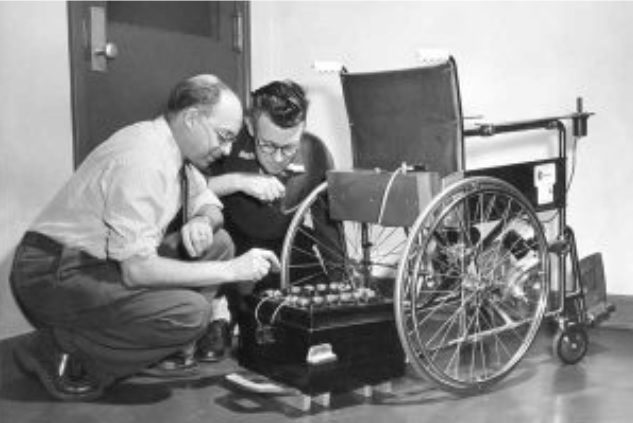
In 1929, after graduating, Klein moved to Ottawa, dedicating 40 years to his work as a mechanical engineer at the National Research Council of Canada (NRC). For some time, he also worked as a designer within the council. Klein collaborated with a diverse group of people, from PhD scientists to tradespeople assembling and fine-tuning machinery. This environment fueled his creativity and led to groundbreaking inventions, including the first electric wheelchair.
The First Electric Wheelchair by Klein
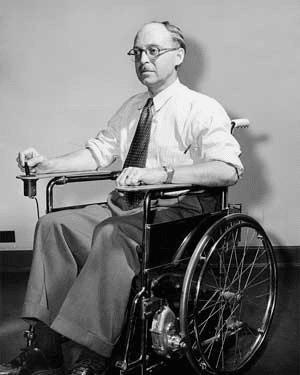
In Ottawa and other Canadian cities, Klein’s invention became known as the “Klein Chair.”
The history of this vital innovation began during the era of penicillin discovery. During World War I, injuries among soldiers often led to fatal infections. However, in World War II, penicillin dramatically increased survival rates among wounded soldiers.
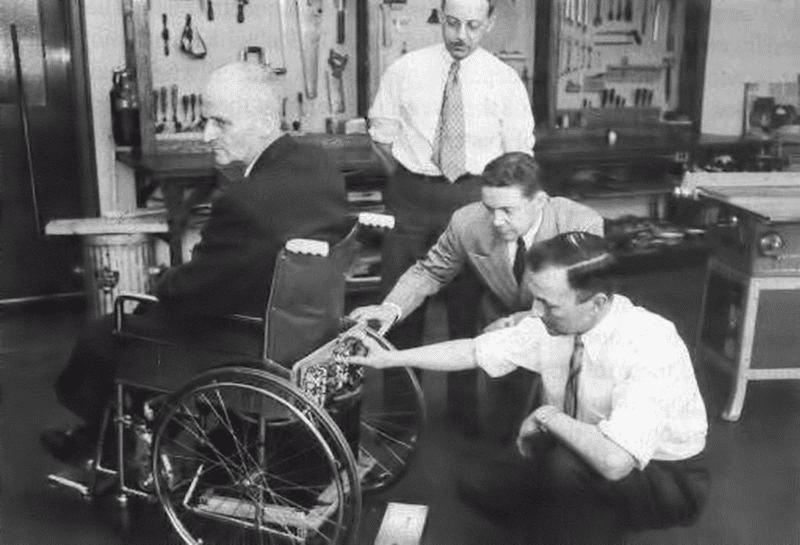
One such soldier was John Counsell, a Canadian officer who was shot in the back during the Dieppe Raid. The injury left him paraplegic, requiring the use of a standard wheelchair for the rest of his life. Despite his condition, Counsell remained actively involved in veteran community activities, attending meetings and events. Inspired by Counsell’s determination, Klein took on the challenge of improving his quality of life. He considered the development of the electric wheelchair his most impactful project.
Klein created an entire system for the electric wheelchair, incorporating a joystick, advanced technological packages, lathe systems, and individual drives. Today, these innovations form the basis of modern electric wheelchairs.
Klein built several electric wheelchairs, which he distributed to World War II veterans, including John Counsell. He then sought international manufacturers to mass-produce the invention. This search proved successful. A prototype was presented to the U.S. Ambassador to Canada, who passed it on to the U.S. President. Within a few years, major American wheelchair manufacturers adopted Klein’s technology to produce electric wheelchairs.
In 2004, the prototype electric wheelchair that Klein had presented to the U.S. President was returned to Canada. It is now part of the permanent collection at the Canada Science and Technology Museum in Ottawa.
George Klein’s electric wheelchair revolutionized mobility for individuals with disabilities, particularly veterans, and his technology remains a cornerstone of modern mobility solutions. His work exemplifies how engineering ingenuity can profoundly impact lives.